
An Interview with Entrepreneur in Residence, Argonne National Lab, David J. Neff
Climate Success Chat #55 - May 4, 2026

For many years, I’ve had the pleasure of partnering with David J. Neff on a number of projects in the climate, change-maker, and innovation spaces. Sometimes, it’s easy to forget that the people we are most familiar with have a lot of novel skills and perspectives to offer to others. This is why I wanted to take a moment to interview David for today’s post. If you like this format, let me know and I’ll bring more interviews to you in the future.
David J. Neff (or DJN as you’ll see many of his friends call him) has spent the last two decades at the intersection of entrepreneurship, capital, and technology. He’s a founder with 2x exits, advised early-stage ventures, and invested in the kind of bets most people weren’t ready to take seriously yet as a VC. Today he is the founder of Neon Syndicate, an investor and serves as a contract Entrepreneur in Residence at Argonne National Laboratory, where he works to close the gap between breakthrough science and market-ready companies in deep tech. In our conversation, I wanted to focus on his work at Argonne since the National Labs are a resource in the United States that many people are not familiar with.
About National Labs
For folks who have never heard of Argonne National Laboratory, how would you describe it? What does an “Entrepreneur in Residence” actually do day to day?
Argonne is a Department of Energy national lab outside Chicago and one of the country’s premier research institutions, with about 3,000+ employees and a $1B+ annual budget. They work on everything from battery chemistry to nuclear energy to advanced computing. Most people have never heard of it, which is kind of the point. They’re not in the business of self-promotion, they’re in the business of solving hard problems.
Get a glimpse at some of the innovation that has come out of the Argonne National Lab in this highlight clip on YouTube.
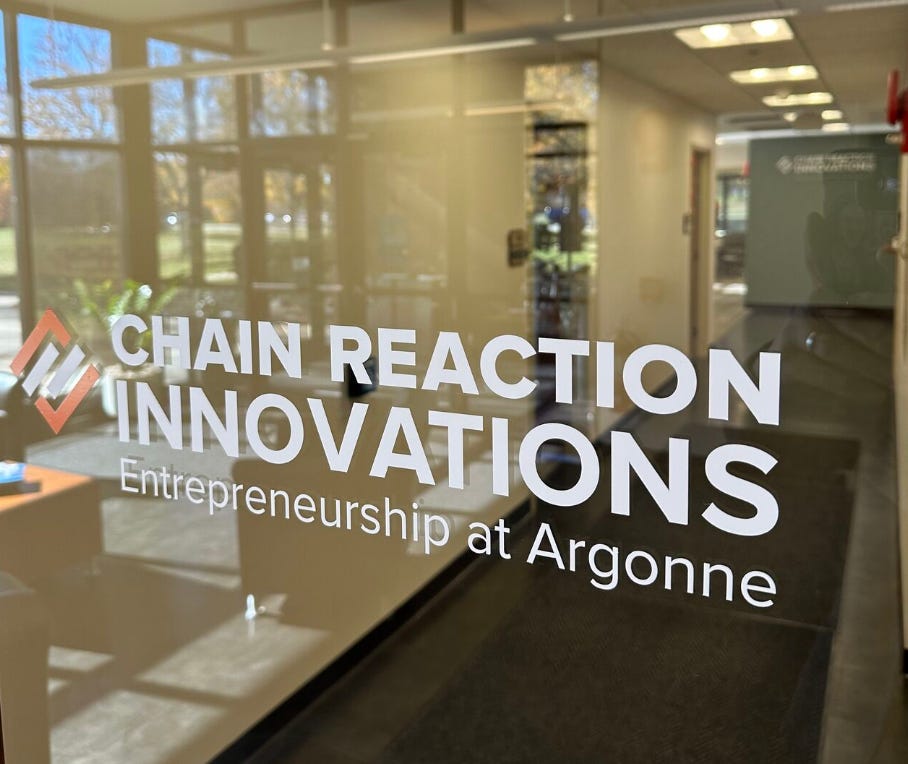
My job as EIR in the Chain Reaction Innovation program is to be the bridge between that world and the commercial one. Day to day that means meeting with founders in the program who have technology that could become a larger company, helping them understand what a market actually wants, connecting them with investors and operators, working with them on term sheets, helping them narrow their ICPs, and being honest when the path to commercialization is harder than they think. It’s part advisor, part translator, part dealmaker.
From Science to Startups
What’s the biggest gap you see between innovative science and a successful company?
Sales and Founder mentality. I saw this as a VC as well. The science is often extraordinary and genuinely world-class work. What’s sometimes missing is someone willing to take personal ownership of getting it to market and then diving into sales and fundraising conversations to make that happen. Researchers are trained to be rigorous and careful, which is exactly what you want in a lab. Founders have to be willing to be wrong fast and course-correct. We like to say “Fail Forward”. Those are sometimes very different muscles. Argonne’s Chain Reaction does a great job finding these people in the program and as an EIR I spend a lot of time helping to broaden their focus.
With federal policy support for clean energy shifting, how are you thinking about where private capital needs to step up?
The places where policy support was doing the most heavy lifting, early-stage deployment, project finance for first-of-kind plants, offtake de-risking, are exactly where private capital needs to get more creative. It won’t look like a 1:1 replacement of government dollars.
It’ll look like new structures: patient capital, family offices with longer horizons, corporates making strategic bets. The money is there. The question is whether it’ll move fast enough and into the right places. I think some of it will, and some technologies will face a harder road than their developers expected. That’s a moment for honest conversation about what’s truly fundable versus what was riding the policy wave.
What categories of clean energy or climate technology are coming out of the national lab ecosystem right now that you think deserve more public attention?
Everything that is part of Argonne’s Chain Reaction Program is worthy of attention. These are founded and established companies that graduate from our world class program and are ready to have a spotlight on them today. If you are reading this and want to meet them, please contact me.
More about David
You’ve had careers as a founder, a VC, and now as an Entrepreneur in Residence at one of the most respected national laboratories in the world. What led you to focus on climate and clean energy today?
That’s an easy one. My son. He was born during Winter Storm Uri here in Austin, TX about five years ago. Having a baby on the way during a grid down, state emergency where the average temperature was 7 F is a life changing experience. After that I quit my job at Accenture and wanted to do something more meaningful in changing the world he was going to grow up in. I applied and got into the fellowship program at Terra.do and made my way into this new world. The urgency makes it feel less like a career choice and more like the obvious next thing.
You’ve described your focus as “energy resilience.” That phrase could mean different things to different people. What does it mean to you?
Mostly my focus is on Deep Tech and Energy startups and I end up working on a lot of university spin outs. But when it comes to Energy Resilience it means the ability to keep the lights on and the economy running when the system gets stressed. That could be a weather event, a grid attack, a supply chain disruption, a geopolitical shock.
Resilience isn’t about any one technology. It’s about redundancy, distributed capacity, and smart infrastructure. When I use the phrase, I’m specifically talking about building systems that don’t have single points of failure. That applies to utilities, to industrial facilities, to communities. The clean energy transition is a massive opportunity, but if we build the next system with the same fragility as the last one, we’ve missed the lesson. I’m actually looking for a lot of startups in this area. If you are reading this and one of them, please reach out to me. I have some great partners for pilots you could be connecting with!
Action and Recommendations
I call this the Climate Success Chat because I like to focus on positive solutions even in the face of setbacks. What keeps you optimistic and motivated?
The people. Every week I’m in a room with someone who has spent ten years figuring out how to make a better battery or a cheaper way to produce green hydrogen or a more efficient heat pump, and they’re not doing it for the money, they’re doing it because they think it matters.
That energy is contagious. I’ve been around a lot of different startup ecosystems, and the people working on climate and energy right now feel different to me. More serious. More committed. That keeps me going even when the policy environment is frustrating or the capital markets are slow. I also think it’s the media I consume, things like this newsletter, Nick at Keep Cool, Just have a Think, Undecided with Matt, etc.
What’s one action you’d recommend readers of this Substack take this week?
Go through your house and start to get rid of as much plastic as you can. As we all know PFAS is real, and the amount of plastic in our home environments is a good place to start.
Start with the kitchen. Get rid of that plastic cutting board, etc. Move into toys, garden tools, etc. Buy wood and metal when you can as much as possible.
If that’s overwhelming for you, check out https://www.terracycle.com/en-US/ where you can learn how to recycle a lot of those things I just mentioned. And a lot of the better brands offer free recycling of their products.
And, one more since Corey and I are old friends, volunteer! Places like Our Children’s Trust, EcoRise and even the farm at Refugee Coalition would love your help.